| Home | Energy Physics | Nuclear Power | Electricity | Climate Change | Lighting Control | Contacts | Links |
|---|
INTRODUCTION:
This web page sets out electromagnetic relationships that govern spheromak geometry.
WHAT IS A SPHEROMAK?
A spheromak is a stable natually occuring quasi-toroidal shaped electromagmetic structure that concentrates and stores electromagnetic field energy.
For quantum charged particles this electromagnetic field energy is the particle rest mass.
Semi-stable spheromaks also occur in plasmas.
The field energy of a spheromak is the sum of its toroidal magnetic field energy, its poloidal magnetic field energy and its radial electric field enegy. In a plasma the particle rest mass is additonal energy.
SPHEROMAK EXISTENCE:
Plasma spheromaks have been photographed, so there is no doubt as to their existence.
A spheromak is a stable distorted toroid shaped electromagnetic structure that naturally forms as a result of a filament of charge Q continuously circulating at the speed of light C forming a current I that flows in a multi-turn closed filament of length Lh. The charge Q is uniformly distributed along the filament length.
Spheromaks form local potential energy wells which give the spheromaks stabiity against minor disturbances.
Basic electromagnetic theory indicates that electric currents flowing in the same direction in parallel filaments cause the filaments to magnetically attract each other. If these parallel filaments have the appropriate net charge per unit length adjacent current filaments electrically repel each other. In circumstances where the electric and magnetic forces on the adjacent filaments are in precise balance a spheromak can exist. This spheromak existence requirement is developed on the web page titled CHARGE FILAMENT PROPERTIES.
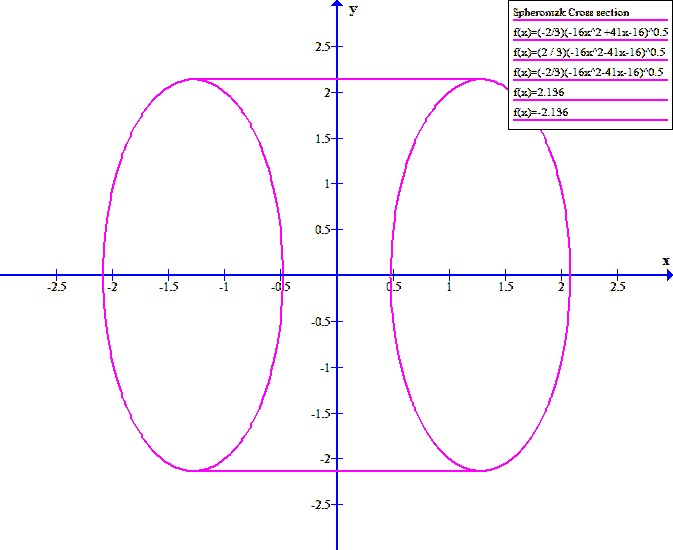
SPHEROMAK WALL DIAGRAM:
The following diagram shows the approximate cross sectional shape of a theoretical spheromak wall in free space. For the purpose of this diagram the assumed spheromak shape parameter Kr is:
Kr = (Rs / Rc)
= 4
SPHEROMAK STRUCTURE:
The geometry of a spheromak is cylindrically symmetric about its central point:
R = 0, Z = 0
and can be characterized by:
its outer radius R = Rs at Z = 0 ,
its inner radius R = Rc at Z = 0
and its height Z = +/- Ho at R = Ro
For the stable spheromak geometry the ratios (Ho / Ro), (Rc / Ro) and (Rs / Ro) are constants irrespective of the magnitude of Ro.
SPHEROMAK FIELD DESCRIPTION:
A spheromak is a semi-stable quasi-toroidal configuration involving net charge Q evenly distributed along filament length Lh, a circulating current:
I = Q C / Lh,
a consequential toroidal magnetic field Bto at R = Ro, Z = 0; a consequential poloidal magnetic field Bpor at R = 0, Z = 0; and consequential radial electric fields Erc at R = Rc, Z = 0 and Ers at R = Rs, Z = 0. The spheromak wall forms the boundary between the inside region containing the toroidal magnetic field and the outside region containing the poloidal magnetic field and the outside radial electric field. It is believed that the spheromak core contains sufficient opposite sign space charge to reduce the inside electric field Erc to zero.
The circulating current filament path has both toroidal and poloidal components, forms the spheromak wall and is a single layer winding with no cross overs.
The filament axis gradually changes direction over the surface of the quasi-toroid shaped spheromak wall. The toroidal magnetic field has two possible directions with respect to the poloidal magnetic field.
At every point on the spheromak wall there is perfect balance between the local internal field energy density and the local external field energy density. The location of this field energy density balance sets the position of the spheromak wall.
Due to a combination of electromagnetic field theory, spheromak wall geometry and prime number theory only certain values of number of toroidal filament turns Nt and number of poloidal filament turn Np can exist in a stable spheromak.
Since the inner spheromak wall and the outer spheromak wall have different radii with respect to the spheromak main axis of symmetry, at the inner spheromak wall the separation between adjacent filaments is less than at the outer wall. Hence the surface electric field is potentially larger at the inner wall than at the outer wall.
The charge Q is evenly distributed over the filament length Lh. Hence the surface charge density S due to the filament winding at the inner perimeter of the spheromak wall is larger than near the outer perimeter of the spheromak wall according to:
S = So (Ro / R)^2
where So is the surface charge per unit area on the spheromak wall at R = Ro.
At the center of the spheromak where R = 0 and Z = 0 the electric field Erc cancels to zero. In the region inside the spheromak wall on the Z = 0 plane the magnetic field is purely toroidal and the electric field is (So / Epsilono)(Ro / R)^2. Outside the spheromak wall on the Z = 0 plane the magnetic field is purely poloidal and the electric field is radial at 2 (So / Epsilono)(Ro / R)^2.
In a spheromak the motion of the positive and/or negative quantum charge along the charge filament causes filament current I and hence poloidal and toroidal magnetic fields. The net charge on the charge filament produces the electric fields. The magnetic force between adjacent charge filament turns balances the electric force between adjacent charge filament turns, allowing the charge filament to form a stable closed path that is the spheromak wall. The spheromak wall shape and circulating current configuration are such that inside the spheromak wall the poloidal magnetic field is zero.
At the stable spheromak geometry the field energy density at the inside surface of the spheromak wall equals the field energy density at the outside surface of the spheromak wall. At this geometry the relative spheromak dimensions are stable and in free space the spheromak has a characteristic shape. The total electromagnetic field energy Ett is inversely proportional to the spheromak characteristic radius Ro.
The average field energy density inside the spheromak wall is less than the average field energy density that would pertain if the spheromak wall did not exist, so that a spheromak forms a potential energy well. This potential energy well gives a spheromak its inherent stability.
Each orthogonal vector field contributes to the spheromak energy and hence to the spheromak rest mass. If the circulating charge consists of multiple particles, each with its own rest mass, the individual particle rest masses further contribute to the assembly rest mass.
STABLE SPHEROMAK:
In a spheromak the motion of the positive and/or negative quantum charges along the charge filament causes filament current I and hence poloidal and toroidal magnetic fields. The net charge on the charge filament produces the external electric field outside the spheromak wall and cancels the electric field inside the spheromak wall. The magnetic force between adjacent charge filament turns balances the electric force between adjacent charge filament turns, allowing the charge filament to form a stable closed path that is the spheromak wall. The spheromak wall shape and circulating current configuration are such that inside the spheromak wall the poloidal magnetic field and the electric field are zero.
The second deriviatives of spheromak energy with respect to spheromak wall position are zero, which cause a slightly disturbed spheromak to spontaneously return to its nominal geometry, in the same way as the machined wheels of a railway carriage tend to keep the railway train upright.
SUMMARY:
A charged filament forming a spheromak is characterized by a charge Q, a filament current I, a stored static electromagnetic energy Ett, and a filament length Lh. Isolated spheromaks in a vacuum have a characteristic geometry and frequency Fh that is proportional to the spheromak contained field energy.:
Fh = C / Lh.
The circulating charge motion gives the spheromak an external poloidal magnetic field and an internal toroidal magnetic field. Note that the internal toroidal magnetic field has two possible directions with respect to the external poloidal magnetic field.
SPHEROMAK PARAMETERS:
R = 0, Z = 0 is the origin of the cylindrical co-ordinate system;
R = the radial distance of a point from the main axis of symmetry where R = 0;
Z = the height of a point above the Z = 0 plane;
There are Nt filament turns that go through the Z = 0 plane in the central core of the spheromak.
Lp = length of one purely poloidal turn;
Lt = length of one purely toroidl turn;
Q = filament charge;
A = Lp Lt Ca = spheromak surface area;
So = Charge per unit area at radius Ro on the spheromak wall;
S(R) = So (R / Ro)^2 =charge per unit area at a point on the spheromak wall;
Lh^2 = (Np Lp)^2 + (Nt Lt)^2
I = Q C / Lh
An important issue in spheromak analysis is that the filament current I is the same everywhere on the filament.
Es = surface electric field
Ep = poloidal magnetic field energy
Et = toroidal magneticfield energy
Er = radial electric field energy
Ett = total field energy
SPHEROMAK CHARACTERISTIC FREQUENCY Fh:
Lh Fh = C
where:
Fh = spheromak characteristic frequency
and
C = speed of light.
PHYSICAL CONSTANTS:
Epsilono = permittivity of free space;
Muo = permiability of freespace;
C = [1 / (Muo Epsilono)]^0.5 = speed of light
SPHEROMAK PARAMETERS THAT SCALE WITH Ro:
Rc, Ro, Rs, Ho, Lp, Lt, Lh;
SPHEROMAK PARAMETERS THAT ARE INDEPENDENT OF Ro:
Np, Nt, (Lh / Ro),
SPHEROMAK PARAMETERS THAT SCALE WITH (1 / Ro):
Btc, Bts, Bto, I
SPHEROMAK PARAMETERS THAT SCALE WITH (1 / Ro)^2:
S, Es, Esc, Ess
SPHEROMAK WALL SURFACE AREA:
A = Integral from R = Rc to R = Rs of:
4 Pi R [(dZ / dR)^2 + 1]^0.5 dR
= Lp Lt
SPHEROMAK WALL SURFACE CHARGE:
Q = Integral from R = Rc to R = Rs of:
4 Pi R (So / R^2) [(dZ / dR)^2 + 1]^0.5 dR
SPHEROMAK WALL GEOMETRY:
The closed filament winding forms the spheromak wall. This filament has Np poloidal turns and Nt toroidal turns. The length Lh of this filament is given by the equation:
Lh^2 = (Np Lp)^2 + (Nt Lt)^2
where:
Lp = the length of a single purely poloidal turn.
and
Lt = the length of a single purely toroidal turn.
SPHEROMAK CHARACTERISTIC FREQUENCY:
Lh = C / Fh
where:
Fh = spheromak characteristic frequency
and
C = speed of light.
INTRODUCTION
In order to make spheromak mathematics practical several simplifying assumptions are adopted.
1) At R = Rs, Z = 0 the external poloidal magnetic field is assumed to be negligibly small.
2) At R = Rc, Z = 0 the poloidal magnetic field is assumed to be:
Bp =' Muo Np I / 2 Ho.
3) The inside electric field on the Z = 0 plane is assumed to be zero;
4) The inside poloidal magnetic field is assumed to be zero;
5) The outside toroidal magnetic field is assumed to be zero.
FIELD ENERGY DENSITY MATCHING AT R = Rs, Z = 0:
Assume that there is a narrow cylindrical static core charge such that the Inside electric field at the outer surface on the equatorial plane is zero.
The outside electric field is:
Ess = [So (Ro / Rs)^2][1 / Epsilono]
= [So / Epsilono][(Ro / Rs)^2]
Bts = (Muo Nt I) / (2 Pi Rs)
Bts^2 / 2 Muo = (Epsilono / 2) Ess^2
Hence field energy density balance at R = Rs, Z = 0::
[(Muo Nt I) / (2 Pi Rs)]^2 / 2 Muo = (Epsilono / 2) {[So / Epsilono]^2 [(Ro / Rs)^2]^2
or
[(Muo Nt I) / (2 Pi Rs)]^2 / 2 Muo = (Epsilono / 2) [So / Epsilono]^2 [(Ro / Rs)^4]
[(Muo Nt I C) / (2 Pi Rs)]^2 = [So / Epsilono]^2 [(Ro / Rs)^4]
[(Nt I / C) / (2 Pi Rs)]^2 = [So]^2 [(Ro / Rs)^4]
[(Nt Q) / (Lh 2 Pi Rs)]^2 = [So]^2 [(Ro / Rs)^4]
Hence:
[Lh / Nt]^2 = {[Q / (2 Pi Rs)]^2} / {[So]^2 [(Ro / Rs)^4]}
The web page titled Spheromak Wall gives:
So = Q (Rs Rc)^0.5 / [4 Pi^2 Ro^2 Rx]
which is the charge per unit area at R = Ro.
and
Rx^2 = (Rs - Ro)(Ro - Rc)
Hence:
[Lh / Nt]^2 = {[Q / (2 Pi Rs)]^2} / {[So]^2 [(Ro / Rs)^4]}
= {[Q / (2 Pi Rs)]^2} / {[Q (Rs Rc)^0.5 / [4 Pi^2 Ro^2 Rx]]^2 [(Ro / Rs)^4]}
= {[1 / (2 Pi Rs)]^2} / {[ (Rs Rc) / [4 Pi^2 Ro^2 Rx]^2 [(Ro / Rs)^4]}
= {[1 / (2 Rs)]^2} / {[ (Rs Rc) / [4 Pi Ro^2 Rx]^2 [(Ro / Rs)^4]}
=[4 Pi Ro^2 Rx]^2 [(Ro / Rs)^4] / Rs Rc 4 Rs^2
= [4 Pi]^2 Ro^8 Rx^2 / (Rs^7 Rc 4)
= 4 Pi^2 Ro^8 Rx^2 / Rs^7 Rc
= 4 Pi^2 Ro^8 (Rs - Ro)(Ro - Rc) / Rs^7 Rc********* Equation (I)
FIELD ENERGY DENSITY MATCHING AT R = Rc, Z = 0:
Btc = (Muo Nt I) / (2 Pi Rc)
Bpc = (Muo Np I) / 2 Ho
Esc = 0Hence energy density matching at R = Rc, Z = 0 gives::
{{(Muo Np I) / 2 Ho]^2 / (2 Muo)} = {[(Muo Nt I) / (2 Pi Rc)]^2 / (2 Muo)}
or
{{(Muo Np I) / 2 Ho]^2 / (2 Muo)} - {[(Muo Nt I) / (2 Pi Rc)]^2 / (2 Muo)} = 0
or
{{(C Muo Np I) / 2 Ho]^2} - {[(C Muo Nt I) / (2 Pi Rc)]^2} = 0
or
[C Muo I]^2 {(Np / 2 Ho)^2 - (Nt / 2 Pi Rc)^2} = 0
or
[I / C]^2 {(Np / 2 Ho)^2 - (Nt / 2 Pi Rc)^2} = 0
Hence:
{(Np / 2 Ho)^2 - (Nt / 2 Pi Rc)^2} = 0
or
(Np / 2 Ho)^2 = (Nt / 2 Pi Rc)^2
or
(Np / 2 Ho) = (Nt / 2 Pi Rc)
or
[Ho / Pi Rc] = Np / Nt]********Equation (II)
FIELD ENERGY DENSITY MATCHING AT R = Ro, Z = Ho:
The internal toroidal magnetic field is:
Bto = Muo Nt I / 2 Pi Ro
The external radial electric field at R = Ro is [So / Epsilono]
Assume that at R = Ro the external magnetic field energy density is equalto the electric field energy density.
Hence at R = Ro, Z = Ho:
Bto^2 / 2 Muo = 2 [Epsilono / 2][So / Epsilono]^2
or
Bto^2 C^2 = 2 [So /Epsilono]^2
or
Bto C = 2^0.5[So / Epsilono]
or
[Muo Nt I C / 2 Pi Ro] = 2^0.5 [So / Epsilono]
or
Nt I C /( 2 Pi Ro C^2) = 2^0.5 So
or
Nt Q C^2/ (Lh 2 Pi Ro C^2) = 2^0.5 So
or
Lh / Nt = Q / [2^1.5 Pi Ro So]
or
{Lh / Nt]^2 = Q^2 / [8 Pi^2 Ro^2 So^2]
The web page titled: Spheromak Wall gives:
So = Q (Rs Rc)^0.5 / [4 Pi^2 Ro^2 Rx]
which is the charge per unit area at R = Ro.
and
Rx^2 = (Rs - Ro)(Ro - Rc)
Hence:
1 / So^2 = [4 Pi^2 Ro^2 Rx]^2 / (Q^2 Rs Rc)
Hence:
[Lh / Nt]^2 = Q^2 / [8 Pi^2 Ro^2 So^2]
= {Q^2 / [8 Pi^2 Ro^2]} {[4 Pi^2 Ro^2 Rx]^2 / (Q^2 Rs Rc)}
= {1 / [8]} {[4 Pi Ro Rx]^2 / ( Rs Rc)}
= {[4 Pi Ro Rx]^2 / ( 8 Rs Rc)}
= 2 Pi^2 Ro^2 Rx^2 / (Rs Rc)
= 2 Pi^2 Ro^2 (Rs - Ro) (Ro - Rc) / (Rs Rc)****************Equation (III)
EXPANSION OF Lh
[Lh / Nt]^2 = [(Np Lp)^2 + (Nt Lt)^2] / [Nt^2]
= [Np / Nt]^2 [Lp]^2 + [Lt]^2
The web page titled: Spheromak Wall gives:
Lt = 2 Pi Rx
Hence:
[Lt]^2 = 4 Pi^2 Rx^2
= 4 Pi^2 (Rs- Ro)(Ro - Rc)
The web page titled: Spheromak Wall gives:
Lp = 2 Pi [(Rs + Rc) / 2]
Hence:
[Lp]^2 = Pi^2{Rs + Rc)^2
Hence expansion of Lh gives:
[Lh / Nt]^2 = [Np / Nt]^2 [Lp]^2 + [Lt]^2
= [Np /Nt]^2 Pi^2 (Rs + Rc)^2 + 4 Pi^2 (Rs - Ro)(Ro - Rc)**********Equation (IV)
MAIN EQUATIONS:
The four asterisk identified equations are:
[Lh / Nt]^2 = 4 Pi^2 Ro^8 (Rs - Ro)(Ro - Rc) / Rs^7 Rc********* Equation (I)
[Ho / Pi Rc] = [Np / Nt]********Equation (II)
[Lh / Nt]^2 = 2 Pi^2 Ro^2 (Rs - Ro) (Ro - Rc) / (Rs Rc)****************Equation (III)
[Lh / Nt]^2 = [Np / Nt]^2 Pi^2 (Rs + Rc)^2 + 4 Pi^2 (Rs - Ro)(Ro - Rc)**********Equation (IV)
Combine equations (I) and (III) to get:
4 Pi^2 Ro^8 (Rs - Ro)(Ro - Rc) / (Rs^7 Rc) = 2 Pi^2 Ro^2 (Rs - Ro) (Ro - Rc) / (Rs Rc)
or
4 Ro^8 / (Rs^7 Rc) = 2 Ro^2 / (Rs Rc)
or
2 Ro^6 / Rs^6 = 1
or
[Ro / Rs]^6 = (1 / 2)
Ro^6 = Rs^6 / 2*********Equation (V)
Ro = [Rs^6 / 2]^(1 / 6) = Rs / 2^(1 / 6)
Ln(2) = 0.6931471806
Ln[2^(1 / 6) = 0.1155245301
Exp(0.1155245301 = 1.122462040
Ro = Rs /1.122462040 = 0.8908987184 Rs
Combine equations (I) and (IV) to get:
[4 Pi^2 Ro^8 (Rs - Ro)(Ro - Rc) / (Rs^7 Rc)] = [Np /Nt]^2 Pi^2(Rs + Rc)^2 + [4 Pi^2 (Rs - Ro)(Ro - Rc)]
or rearranging:
[Np /Nt]^2 Pi^2 (Rs + Rc)^2 = [4 Pi^2 Ro^8 (Rs - Ro)(Ro - Rc) / (Rs^7 Rc)] - [4 Pi^2 (Rs - Ro)(Ro - Rc)]
= 4 Pi^2 (Rs - Ro) (Ro - Rc) {[Ro^8 / (Rs^7 Rc)] - 1}
Recall that Equation (V) gives:
Ro^6 = Rs^6 / 2
Hence:
[Np /Nt]^2 Pi^2{[(Rs + Rc)]^2
= 4 Pi^2 (Rs - Ro) (Ro - Rc) {[Ro^2 / (2 Rs Rc)] - 1}
[Np / Nt]^2 = 4 (Rs - Ro) (Ro - Rc) {[Ro^2 / (2 Rs Rc)] - 1} / [(Rs + Rc)]^2********Equation (VI)
Np, Nt are integers with no common factors.
Ro = (1 / 2)^(1 / 6) Rs
= (1 / 2)^(1 / 6) Kr Rc
= Kn Kr Rc
where:
Kr = Rs / Rc
Hence:
[Np / Nt]^2 = 4 Rx^2 {[(Kn Kr Rc)^2 / (2 Kr Rc Rc)] - 1} / [Rc(Kr + 1))]^2
= 4 (Rx / Rc)^2 {[(Kn^2 Kr) / 2] - 1} / [(Kr + 1)^2]
Hence:
Rx^2 = (Rs - Ro)(Ro - Rc)
= Rs (1 - Kn)(Kn Rs - Rc)
= Kr Rc (1 - Kn)(Kn Kr - 1) Rc
= Kr Rc^2 (1 - Kn)(Kn Kr - 1)
Then:
(Rx / Rc)^2 = Kr (1 - Kn)(Kn Kr - 1)
Thus:
[Np / Nt]^2 = 4 (Rx / Rc)^2 {[(Kn^2 Kr) / 2] - 1} / [(Kr + 1)^2]
= 4 Kr (1 - Kn)(Kn Kr - 1) {[(Kn^2 Kr) / 2] - 1} / [(Kr + 1)^2]*********************Equation (VII)
Thus Equation (VII) gives: [Np / Nt]^2 as a function of Kr.
FIND [Ho / Rc] BY INTEGRATION:
Let:
Kr = (Rs / Rc)
and from the web page titled:
Spheromak Wall
(Ho / Rc) = Integral from R = Rc to R = Ro of:
[1 / Rc] [dZ / dR] dR
= Integral from R = Rc to R = Ro of:
{[Rx^2 / (Rs - R) (R - Rc)]^0.5 - 1}^0.5 (dR / Rc)
= Integral from R = Rc to R = Ro of:
{[(Rx / Rc)^2 / ((Rs / Rc) - (R / Rc)) ((R / Rc) - 1)]^0.5 - 1}^0.5 (dR / Rc)
Let X = (R / Rc)
Then:
[Ho / Rc] = Integral from X = 1 to X = (Ro / Rc) of:
{[(Rx / Rc)^2 / (Kr - X) (X - 1)]^0.5 - 1}^0.5 (dX)
Recall that:
Rx^2 = (Rs - Ro)(Ro - Rc)
and
Ro^6 = [Rs^6 / 2]
or
Ro = Rs kn
or
(Ro / Rc)= Kr Kn
where:
Kn= (1 / 2)^(1 / 6)
Hence:
Rx^2 = (Rs - Ro)(Ro - Rc)
= Rs (1 - Kn)(Kn Rs - Rc)
= Kr Rc (1 - Kn)(Kn Kr - 1) Rc
= Kr Rc^2 (1 - Kn)(Kn Kr - 1)
Then:
(Rx / Rc)^2 = Kr (1 - Kn)(Kn Kr - 1)
Thus:
[Ho / Rc] = Integral from X = 1 to X = (Ro / Rc) of:
{[(Rx / Rc)^2 / (Kr - X) (X - 1)]^0.5 - 1}^0.5 (dX)
Thus[Ho / Rc] is a function of Kr = (Rs / Rc). This function can be determined by numerical integration, Note that Kn = (1 / 2)^(1 / 6)
From Equation (II):
[Np / Nt] = Ho / Pi Rc
or
[Np /Nt]^2 = [Ho / Pi Rc)^2 *********Equation (IX)
Thus we have two equations [Equation (VII) and Equation (IX)] for [Np / Nt]^2 versus Kr. They can be graphically solved to find (Np / Nt)^2 and Kr.
Kr = (Rs / Rc) is a constant common to all spheromaks, as are (Lh / Rc) and Nt. Hence Np is common to all spheromaks.
Once (Np / Nt)^2 is determined solve for Np and Nt using the methodlogy set out on the web page titled: Spheromak Winding to find Np, Nt, and prime number P, where Np and Nt are positive integers with no common integer factor except one.
********************************************************************
Filament Length Each half toroidal turn requires L^2 = (Lt / 2)^2 + 2 Pi Rs Np Charge /length = Q / Lh Charge / area = S Total charge = Integral s dA = So (Ro / R)^2 4 Pi R dLt Total length = [(Np Lp)^2 + (Nt Lt)^2]^0.5 Charge / Unit length = Integral So (Ro / R)^2 4 Pi R dLt / [(Np Lp)^2 + (Nt Lt)^2]^0.5 = Q / LhENERGY
It is shown that the total electromagnetic field energy Ett trapped by a spheromak is proportional to (1 / Lh) where:
Lh^2 = (Np Lp)^2 + (Nt Lt)^2
Current moves along the spheromak closed path length Lh at speed of light C. Hence the natural frequency F of the path length Lh is:
F = C / Lh.
A spheromak's total field energy is Ett.
Ett / F = Ett Lh / C = h
Expressions for Ett typically contain the factor (1 / Lh) so that calculations of (Ett Lh / C) result in the constant h.
Hence:
Hence, Ett is proportional to frequency F.
Ett = h F
The proportionality constant is known as the Planck constant h
Thus spheromaks are the cause of photon energy quantization.
The main focus herein is on spheromaks that define quantum charged particles. Note that due to the absence of an electric field the geometry of a neutral spheromak is slightly different and less stable than the geometry of a spheromak with a net charge. Similarly, the spheromak defining a neutral atom with a central positive charge is slightly different again. The geometry of a spheromak composed of plasma ions and free electrons is slightly different again. The situation of spheromaks inside solids or liquids different again. Hence the exact value of h depends on the measurement circumstance.
The accepted experimental value of h measured with a Kibble Balance, although highly repeatable, is dependent on the spheromak structure relevant to the experiment.
Hence:
dEtt / dFh = C (dEtt / dLh)
= h
We need to use electromagnetic theory to find the stable values of Np, Nt, and (dEtt / dRo)
where Np, Nt are integers.
Experimental plasma photographic data indicates that:
Rs / Rc ~ 4
SPHEROMAK APPLICATIONS:
In general, each quantum charged particle has an associated a spheromak. Spheromks have ground states and various excited states. The extent of spheromak excitation is determined by its radiation environment. At equilibrium the rate of radiation emission by a spheromak is equal to its rate of radiation absorpion.
Hot gas atoms absorb or emit electromagnetic photons at various characteristic frequencies. That is the basis of gas spectroscopy.
An isolated spheromak normally has a unique stable energy state. A spheromak subject to an external magnetic field has two discrete energy states. When there is a suitable applied external magnetic field spheromaks can jump between the two discrete energy states by absorption or emission of an electromagnetic photon of the appropriate frequency. This phenomena is variously known as nuclear magnetic resonance (NMR) and electron spin resonance (ESR).
NMR of hydrogen nuclei in body tissue is widely used for medical imaging.
SPHEROMAK APPLICATIONS:
Spheromaks are involved in the charged particle photon absorption and emission that occurs on application of an external magnetic field and as a result of thermal excitation of gases.
An isolated spheromak has a unique stable energy state solution. An isolated spheromak subject to an external magnetic field has two discrete energy states. When there is a suitable applied external magnetic field spheromaks can jump between the two discrete energy states by absorption or emission of an electromagnetic photon of the appropriate frequency.
This phenomena is variously known as nuclear magnetic resonance (NMR) and electron spin resonance (ESR). NMR of hydrogen atoms in body tissue is widely used for medical imaging.
In situations where there are multiple interacting spheromaks there is a spectrum of discrete energy state solutions.
Hot gas atoms also absorb or emit electromagnetic photons at various characteristic frequencies. That is the basis of gas spectroscopy.
In an experimental apparatus known as a Kibble Balance the Planck constant h is reproducible to many significant figures, so today this experimentally measured constant is used to relate international standard units of energy (mass) to international standard units of time (frequency).
FURTHER SPHEROMAK ATTRIBUTES:
A free neutron is a neutral spheromak formed by an electron and a proton. In a nuclear reactor after a few minutes a free neutron will spontaneously decay into a proton, an electron and an anti-neutrino. However, in an atomic nucleus, which imposes its own electric and magnetic fields, a neutron is often very stable.
Spheromaks can electrically and magnetically bind together and/or merge to form nucleii and atomic assemblies with larger rest energy.
The quantum electron charges around an atomic nucleus form multi-particle spheromaks. About half of these quantum electron charges move poloidally opposite to the other half to minimize the net poloidal magnetic field.
The spheromak structure of atomic electrons explains experimentally observed atomic ionization energies and chemical bonding.
Nucleons tend to arrange themselves so that the nuclear constituant poloidal magnetic fields cancel.
The spheromak mathematical model allows precise calculation of the contribution of particle electric and magnetic field energies to electron and proton rest masses.
Plasma spheromaks are used for energy and fuel injection in some nuclear fusion processes. "Ball Lightning" is an occasionally observed form of plasma spheromak.
The spheromak mathematical model predicts the experimentally measured Planck constant h, and the corresponding Fine Structure constant Alpha which are fundamental to quantum mechanics. Generally, in any physical process that exhibits energy quantization in accordance with the Planck constant, there is an underlying spheromak.
DISCRETE INTEGER SOLUTIONS:
There is a further aspect of charge filaments that is important. In order for a spheromak to be stable over time each circuit of the filament must be identical to every other such circuit. Hence for the spheromak to be stable the number of toroidal turns Nt and the number of poloidal turns Np included in length Lh must both be integers. Furthermore, the filament path length ratio
[(Np Lp) / (Nt Lt)] = Mp / Mt,
where Mp and Mt are integers that have no cmmon factors other than unity.
SPHEROMAK NET CHARGE:
Net charge Qs on the spheromak is given by:
Qs = Qp Nph + Qn Nnh
SPHEROMAK FIELD ENERGY DENSITY FUNCTIONS:
A spheromak has four cylindrically symmetric field energy density functions:
Ut(R,Z) = toroidal magnetic field energy density function
Up(R,Z) = poloidal magnetic field enegry density function
Ue(R,Z) = outside radial electric field energy density function
Ui(R, Z) = inside radial electric field energy density function
The spheromak has two regions which are separated by the thin closed spheromak wall.
Everywhere in the region inside the spheromak wall the field energy density U is given by:
U = Ut(R, Z)
where:
Ut(R, Z) < Up(R, Z) + Ue(R,Z)
Everywhere in the region outside the spheromak wall:
U = Up(R,Z) + Ue(R, Z)
where:
Ut(R, Z) > Up(R, Z) + Ue(R, Z)
Hence the spheromak forms a potential energy well.
Everywhere on the spheromak wall:
Ut(R, Z) + Ui(R, Z)= Up(R, Z) + Ue(R,Z).
Ths equation defines the position of the spheromak wall.
SPHEROMAK SYMMETRY:
Spheromaks exhibit mirror symmetry about the equatorial plane. Hence:
Z(R) = - Z(R)
and
U(R, Z) = U(R, - Z)
Hence:
Ett = Integral from Z = - infinity to Z = + infinity of:
Integral from R = 0 to R = infinity of:
U(R, Z) 2 Pi R dR dZ
= Integral from Z = 0 to Z = infinity of:
U(R, Z) 4 Pi R dR dZ
SPHEROMAK WALL POSITION:
The position of the spheromak wall corresponds to the lowest available spheromak energy state. At this state the spheromak energy density distribution is U(R, Z) where:
inside the spheromak wall:
U = Ut(R)
and outside the spheromak wall:
U = Up(R, Z) + Ue(R,Z)
and at the spheromak wall:
Ut(R) = Up(R, Z) + Ue(R,Z)
ISOLATED SPHEROMAKS:
Spheromaks are used by nature to form particles that are local concentrations of charge and electromagnetic field energy. We commonly refer to this locally concentrated electromagnetic field energy as rest mass. Spheromaks are instrumental in nuclear and atomic particle interactions. Spheromaks also have important roles in semi-stable plasmas, chemical binding and thermal radiation.
An isolated spheromak has a unique energy state solution. An isolated spheromak in an external magnetic field has two energy state solutions. When there are multiple interacting spheromaks there is a spectrum of discrete energy state solutions.
Spheromaks gain or lose energy by absorption or emission of electromagnetic radiation.
BOUNDARY CONDITIONS:
For an isolated charged particle spheromak in a vacuum the electric field inside the spheromak wall is zero.
For an isolated spheromak the field energy density outside the wall is the sum of the energy densities caused by the electric field due to fixed charge Qs and by the polodal magnetic field arising from current circulation. The field energy density inside the spheromak wall is caused only by the toroidal magnetic field that arises from toroidal current circulation in the spheromak wall.
Thus, from basic electromagnetic theory inside the spheromak wall the toroidal magnetic field is given by:
Bt = Muo Nt I / 2 Pi R
so inside the spheromak wall the toroidal magnetic field energy density is given by:
Ut = Bt^2 / 2 Muo
= [Muo Nt I / 2 Pi R]^2 / 2 Muo
= Muo Nt^2 I^2 / 8 Pi^2 R^2
where:
Muo = permiability of free space = 4 Pi X 10^-7____
Pi = 3.14159265
Nt = number of toroidal turns
I = circulating current
R = the radial distance from the main axis of spheromak symmetry, herein referred to as the Z axis.
This region inside the spheromak wall exists within a larger region outside the spheromak wall where the magnetic and electric field energy densities are approximately equal to the magnetic and electric fields produced by a current ring located at R = Ro, Z = 0 carrying a current (Np I) and having net charge Qs.
SPHEROMAK STABILITY:
Spheromak stability arises from prime number constraints that affect Np and Nt as well as from formation of a potential energy well inside the spheromak wall. Due to a combination of electromagnetic field theory, spheromak geometry and prime number theory only certain values of Nt and Np can exist in a stable spheromak.
The integers Np and Nt cannot be equal and cannot have a common factor other than unity. As a result of Np and Nt having no common factors the filament current path (winding) has only one layer with no cross overs. The filament only intersects itself at the current path closure point. Spheromak stability suggests that small errors in Np or Nt should lead to self correction rather than spheromak collapse.
Apart from the constraints on Np and Nt detailed analysis shows that spheromaks are stable due to formation of an energy well inside the spheromak wall.
The optimum spheromak geometry is stable over a wide range of spheromak energy. The spheromak wall relative gepmetry remains constant and can be geometrically characterized by the size parameters Ro. For a stable spheromak the ratios: (Ho / Ro), (Rc / Ro) and (Rs / Ro) remain constant independent of the spheromak's total field energy.
The stable spheromak structure enables the existence of isolated charged particles and semi-stable plasmas. Particles with rest mass are stable packets of charge and energy that are non-propagating solutions to electromagnetic equations. Hence atoms and charged atomic particles embody spheromaks.
SPHEROMAK WINDING:
The spheromak winding has Npo poloidal turns and Nto toroidal turns.
The numbers Np and Nt are positive integers with various special mathematical properties.
The winding length Lh is given by:
Lh^2 = (Np Lp)^2 + (Nt Lt)^2
= [Np 2 Pi Ro]^2 + [Nt Lt]^2
where:
Lp = 2 Pi Ro
is the length of a single poloidal filament winding turn and
Lt =
is the length of a filament winding turn that encircles the toroidal magnetic flux once.
The spheromak inner wall and the spheromak outer wall have different radii with respect to the main axis of symmetry. Hence, at the inner wall the current filament to current filament distance is less than at the outer wall. Since the net charge is evenly distributed along the filament this issue causes the surface charge per unit area at the outer wall to be less than the surface charge per unit area at the inner wall.
The current filament turns occur in a single layer which contains no cross overs. The current path only intersects itself at the current path closure point. The spheromak must remain stable in the presence of small geometric disturbances that can cause either Np or Nt to increment or decrement from their nominal Np = Npo and Nt = Nto values. Hence, in a stable spheromak, Npo and Nto are not equal and do not share a common integer factors other than 1. Similarly there is no common factor sharing between: Npo + 2, Nto - 1; between Npo - 2 and Nto + 1.
Spheromak stability is enhanced if a small energy disturbance does not lead to spheromak collapse. Then if there is a disturbance that increments/decraments only Np or only Nt the spheromak remains stable.
Any point on the spheromak winding can be identified by its Phi and Theta values. Phi is the angle about the major axis of symmetry measured with respect to a radial line from the minor axis to the orgin. Theta is the angle about the minor axis at R = Ro, Z = 0 measured with respect to the same radial line. Hence at the current path closure point:
Phi = 0, Theta = 0 or Phi = 2 Pi Np, Theta = 2 Pi Nt
The range of Phi is:
0 < Phi < 2 Pi Npo radians;
The range of Theta is:
0 < Theta < 2 Pi Nto radians
The average value of dTheta / dPhi is given by:
dTheta / dPhi = 2 Pi Nto / 2 Pi Npo
= Nto / Npo.
However, in a spheromak dTheta / dPhi varies slightly along the winding and is a function of R.
Symmetry indicates that at the center of the spheromak core the net electric field is zero.
SPHEROMAK TOTAL FIELD ENERGY:
The spheromak total field energy given by:
Ett = Integral over all space of:
U(R, Z) 2 Pi R dR dZ
Spheromaks are used by nature to form particles that are local concentrations of electromagnetic field energy. We commonly refer to this locally concentrated electromagnetic field energy as rest mass. Spheromaks are instrumental in nuclear and atomic particle interactions. Spheromaks also have important roles in semi-stable plasmas, chemical binding and thermal radiation.
An isolated spheromak has a unique energy state solution. An isolated spheromak in an external magnetic field has two energy state solutions. When there are multiple interacting spheromaks there is a spectrum of discrete energy state solutions.
Isolated spheromaks gain or lose energy by absorption or emission of electromagnetic radiation.
NATURAL FREQUENCY:
In certain circumstances a stable atomic particle spheromak can absorb quantum amounts of electromagnetic radiation (photons) with energy Ep = h Fp where:
Ep = photon energy
h = Planck constant
Fp = photon frequency
The change in the total field energy content of a spheromak dEtt is proportional to its change in frequency dFh.
The PLANCK CONSTANT h is a combination of physical constants that arise from the geometry of a quantum charged spheromak.
CHARACTERISTIC FREQUENCY:
In an atomic particle the time required for movement of net charge:
(Qp Nph + Qn Nnh)
at velocity C around the closed charge filament path of length Lh gives the spheromak a characteristic frequency Fh where:
Fh = C / Lh
For a given net electric charge Qs the smaller a spheromak is the more total energy Ett that it traps and the higher is its characteristic frequency Fh. If an atomic particle spheromak's energy changes due to photon capture or photon emission while the spheromak net charge Qs remains constant there is a corresponding change in spheromak size and hence there is a corresponding change in the spheromak characteristic frequency Fh. An emitted or absorbed photon must reflect both the change in total spheromak energy
(Ettb - Etta)
and the change in the spheromak characteristic frequency
(Fhb - Fha).
Note that the emitted or absorbed photon frequency is at the beat frequency difference between the initial spheromak frequency Fha and the final spheromak frequency Fhb.
Expressed mathematically:
(Ettb - Etta) = h (Fhb - Fha)
= h [(C / Lhb) - (C / Lha)]
Provided that the spheromak relative geometry remains constant:
Lhb / Lha = Rob / Roa
RADIATION AND MATTER:
The existence, mass and other properties of each spheromak and hence each real atomic particle is governed in part by the prime number P that simultaneously satisfies all of the spheromak constraint equations. Since P, and the spheromak winding parameters Np and Nt must be integers and Np and Nt cannot share common factors the number of such prime numbers and hence the number of real atomic particle possibilities is distinctly limited.
If a spheromak's static electromagnetic field energy Ett changes from Ea to Eb and the spheromak frequency Fh changes from Fa to Fb then:
dEtt = (Ea - Eb)
= h (Fa - Fb)
= h dFh
Over time spheromaks in free space will absorb or emit energy until they reach a stable state.
At this stable state the value of (dEtt / dFh) for an electromagnetic spheromak is given by:
(dEtt / dFh) = h,
where:
Fh = the natural frequency of the circulating quantum net charge that forms an electromagnetic spheromak and dFh is the frequency of a radiation emitted or absorbed.
This formula is the basis of quantum mechanics. Spheromaks form the static field structure of charged particles with rest mass. Since spheromaks are the main sources and sinks of radiant energy, spheromak properties in large measure determine the radiant energy absorption and emission properties of matter.
On this web site we are primarily concerned about spheromaks in free space. Spheromaks in an atomic, molecular or crystal environment present additional complications.SPHEROMAK TRANSIENT BEHAVIOR:
When a spheromak first forms the spheromak will emit photons in order to reach its most stable energy state at which state it is in radiation balance with its environment. In a low radiation environment that is the spheromak minimum energy or ground state.
The electrons surrounding an atomic nucleus form spheromaks with nearly cancelling poloidal magnetic fields.
NO RADIATION IN THE GROUND STATE:
An important property of an isolated charged particle spheromak is that in its minimum energy state, also known as its ground state, the spheromak does not emit radiation. This property enables the existence of stable quantum charged particles, stable atomic nuclei and stable atoms. Note that as a spheromak approaches it ground state its radiation emission becomes very small. Possibly much of the cosmic background radiation is due to gradual spheromak energy decay.
That low level radiation will only cease when the prevailing temperature is at absolute zero.
RELATED MATERIAL ON THIS WEB SITE:
At other web pages on this web site spheromak energy density functions are developed in terms of spheromak geometrical size, poloidal and toroidal turns, charge and current parameters. The spheromak energy density functions are shown to yield spheromaks with known static electric and magnetic field energy content. Hence the total spheromak static electric and magnetic field energy is expressed in terms of measureable parameters. It is shown that quantum mechanical properties, such as the Planck constant and Fine Structure constant, arise from these parameters.
The utility of the spheromak mathematical model is demonstrated by comparison of predictions from the spheromak mathematical model to experimental data. Spheromaks account for most experimentally observed quantum mechanical phenomena.
The result is a practical mathematical model that gives relatively simple closed form solutions to problems that would otherwise likely require extensive computing power.
Other spheromak issues include: plasma spheromak circulating electron kinetic energy, the number of free electrons in a plasma spheromak, the plasma spheromak enclosure size and plasma spheromak lifetime.
This web page last updated May 14, 2026.
| Home | Energy Physics | Nuclear Power | Electricity | Climate Change | Lighting Control | Contacts | Links |
|---|